
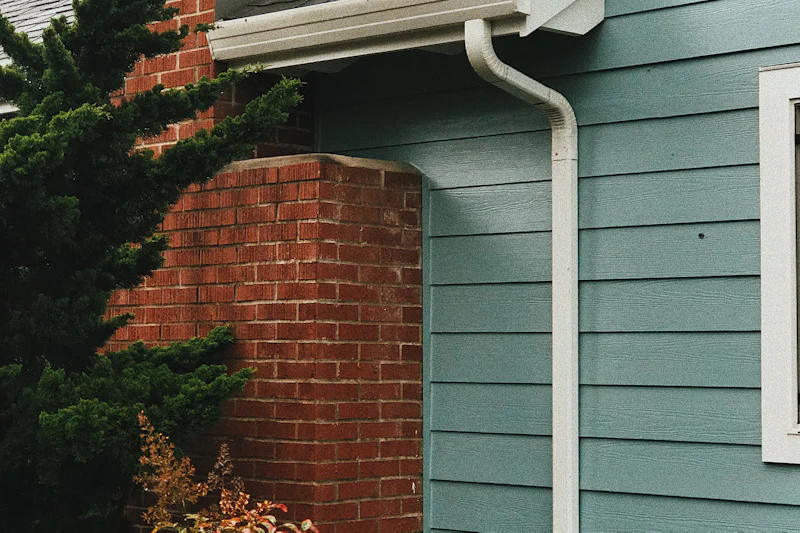
Siding replacement in Fort Wayne
When we do siding replacement on a Fort Wayne house, the old siding usually comes off, the soft spots get fixed and the house gets wrapped before a new panel goes up.
Time to re-side, or just repair?
Repair makes sense when the damage is in one place: a hail-cracked wall, a few loose panels, one corner where a gutter overflowed. Replace when you see these across the house:
- Vinyl that's brittle, cracked in cold weather, or faded unevenly from wall to wall
- Panels buckled or wavy, often from being nailed too tight
- Wood or hardboard siding swelling, flaking or soft at the bottom edges
- Water stains, peeling paint or mold on the inside of outside walls
- Aluminum siding dented and chalky, with the color rubbing off on your hand
Small jobs are covered on the siding repair in Fort Wayne page.
How much siding replacement costs in Fort Wayne
Nationally, re-siding a house of about 2,000 square feet runs $8,500 to $20,000, with $14,500 typical. Material sets most of that, and labor runs about $1 to $4 a square foot of wall.
| Siding | Installed, per sq ft |
|---|---|
| Vinyl | $3 to $12 |
| Engineered wood | $2 to $10 |
| Fiber cement | $5 to $14 |
| Wood | $2 to $15 |
| Aluminum | $3 to $10 |
| Steel | $4 to $16 |
Removing the old siding adds about $1,000 to $2,500 for the house. Rotted sheathing found underneath is priced separately, board by board.
Vinyl in a northern Indiana winter
Vinyl grows and shrinks with the temperature, so it has to hang loose. The industry installation manual calls for nails left about 1/32 inch proud of the panel and at least 1/4 inch of clearance at corners, trim and window openings, widened to 3/8 inch when it's installed below 40°F. Panels nailed tight are the usual reason vinyl ripples on a hot August afternoon.
Vinyl can go up in winter. Installers cut it more slowly when it's cold, because it's more brittle then.
What a full re-side includes
Whichever siding contractor you hire, the quote for a full re-side should cover these five steps.
- Old siding comes off and gets hauled away, unless the quote says new goes over old.
- Soft sheathing gets replaced and nails get set, so the wall is flat enough for new siding.
- House wrap goes on lapped from the bottom up, with flashing at every window, door and roof line.
- Trim goes on next: corner posts, J-channel around openings and starter strip at the base.
- The new siding goes up last, with courses kept level around the house and joints staggered.
We take the old siding off on nearly every job. Siding over siding saves the tear-off cost, but then nobody sees the wall behind it.
Permits and historic districts in Fort Wayne
Re-siding needs a building permit in Fort Wayne and the rest of Allen County: the county's residential permit guide lists siding with roofing as permitted work. In the city's local historic districts, siding seen from the street also needs a Certificate of Appropriateness first, and the guidelines treat covering wood siding with vinyl or aluminum as not appropriate. Repairs that match what's there, in material and look, count as routine maintenance and don't need one.
Older houses: what's under the siding
Many older houses have vinyl or aluminum over the original painted wood. On a house built before 1978, removing or cutting into that painted wood can disturb lead paint. Once the work disturbs more than 20 square feet of painted surface outside, the firm has to be EPA Lead-Safe Certified and use lead-safe work practices.
Siding replacement questions
What makes new siding last in Indiana?
Flashing at every window, door and roof line does the most, because water that gets behind siding is what rots the wall. We take as much care with the flashing as with the siding you can see.
Can new siding go over old siding?
Sometimes, over flat and sound siding, and it saves the $1,000 to $2,500 tear-off. You give up the chance to see and fix the wall underneath, and some makers' warranties require the old siding off. Ask what the product's instructions say.
Does insulated vinyl siding make a difference?
Yes, a little: foam bonded to the back of each panel adds some insulation over the studs and makes the panel lie flatter. It costs more per square foot than plain vinyl.
What's the best time of year to re-side?
Any season can work for vinyl and prefinished boards, which go up in cold weather too, with wider gaps for vinyl, while fiber cement and wood painted on site do best in dry weather. Spring through fall is the busiest stretch.
Does my homeowners insurance cover siding?
If hail or a windstorm did the damage, your policy may pay for it. Take photos before anything is removed, and we'll write up an estimate you can hand the adjuster.
What the quote usually covers
Usually included
- Old siding removed and hauled off
- House wrap and window flashing checked
- New siding, corners and trim
Often priced separately
- Rotted sheathing found under the old siding
- Insulated backer board
- New gutters, soffit or fascia
Confirm both lists in your written quote.
Get your free in-home estimate
A few quick questions. Here's what happens next:
- We call you backTo hear about your house and pick a time that works for you.
- We measure everythingEvery window and wall, so your price is right the first time.
- You get it in writingProduct, trim, clean-up and a start date, all on one page.
Other services
Let's take care of your house
Call us or send a few quick answers. We'll come out, measure everything and give you a clear price in writing.